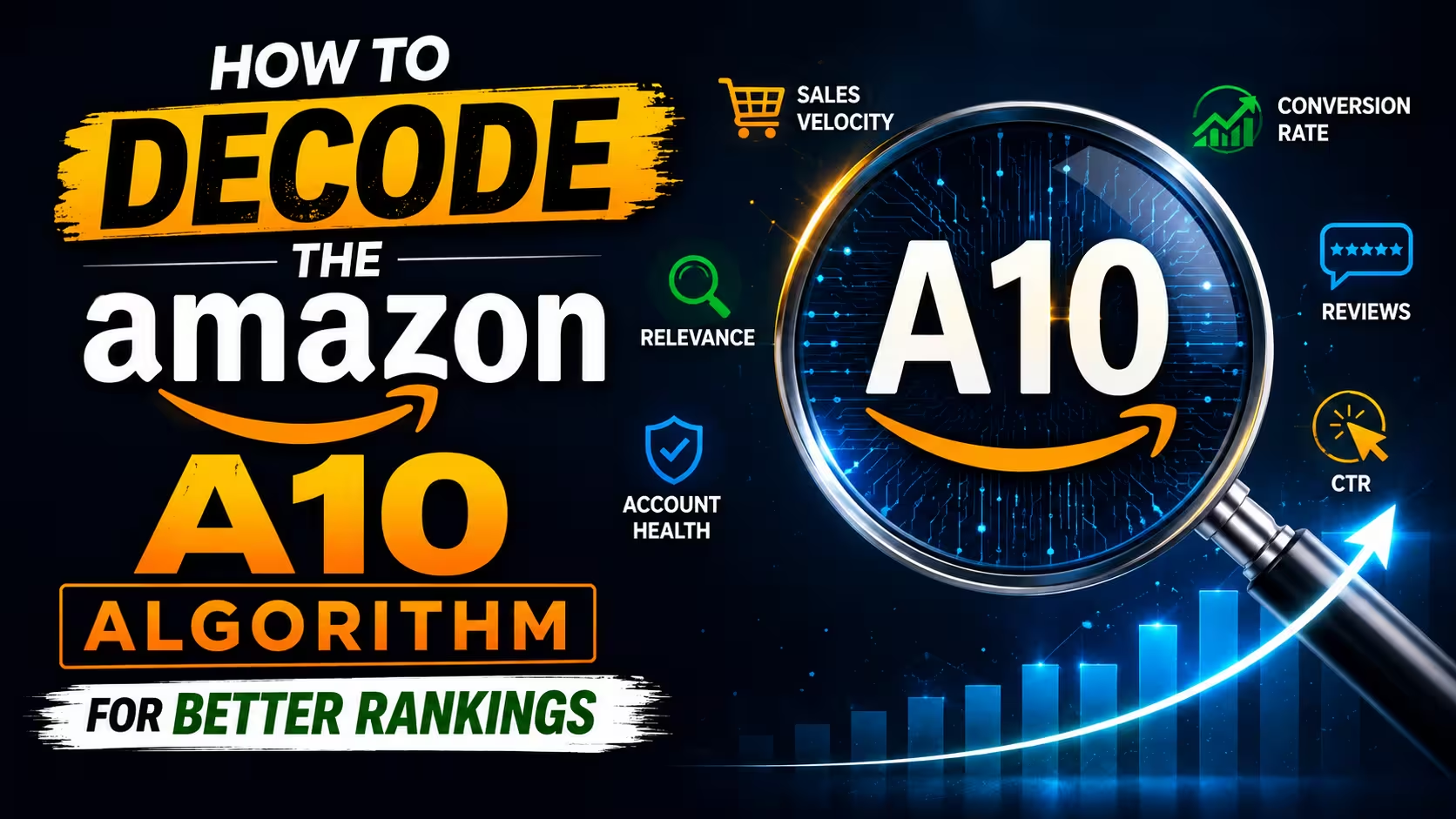
A10: The Algorithm That Redefines Marketplace Dominance
The Amazon A10 algorithm has replaced the legacy A9 model with a sophisticated, AI-mediated search environment. While outdated strategies focused solely on sales velocity, A10 prioritizes buyer intent, seller authority, and external traffic as primary ranking signals. Brands clinging to simplistic, ad-heavy tactics now face stagnant organic visibility as the platform rewards listings that solve specific customer needs.
Achieving first-page dominance requires a shift from manual optimization to a precise, data-driven system. TrySaleBooster provides a reverse-engineered A10 framework that synchronizes semantic keyword mapping with behavioral engagement metrics. Unlike agencies that rely on generic best practices, we deploy proprietary growth engines to track performance through Amazon Attribution, ensuring every signal—from keyword relevance to off-platform demand—is engineered for measurable revenue growth.
Amazon SEO: The Revenue Engine Behind A10

Amazon SEO is the systematic process of optimizing product listings and catalog architecture to dominate the A10 algorithm, ensuring your brand captures maximum visibility within marketplace search results. Unlike generic search optimization, Amazon SEO functions as a high-stakes revenue engine where search rankings directly correlate to sales velocity, conversion rates, and organic market share.
What is Amazon SEO and why is it critical for e-commerce growth?
This discipline is critical for growth because the A10 algorithm prioritizes products that demonstrate consistent, high-velocity performance, effectively rewarding brands that achieve top-tier visibility with compounding organic sales. Brands utilizing the proprietary technology of TrySaleBooster translate this into predictable growth by synchronizing keyword mapping with high-velocity ad scaling. Without such data-driven catalog health, brands face unsustainable customer acquisition costs and plummeting discoverability. While competitors often rely on manual, fragmented efforts, TrySaleBooster provides a reverse-engineered A10 framework to ensure that every ranking gain directly compounds revenue and long-term brand authority.
A10 vs. A9: What Really Changed
The evolution from the legacy A9 model to the Amazon A10 algorithm signals a transition toward a search environment that prioritizes holistic brand credibility over simple, PPC-driven sales velocity. While A9 relied heavily on internal conversion data and ad spend to rank products, A10 interprets user intent through a lens of total brand authority and genuine organic engagement.
How does the Amazon A10 algorithm differ from previous iterations?
The transition from A9 to A10 represents a fundamental shift from prioritizing simple sales velocity to valuing holistic brand authority and organic engagement. While the A9 model centered primarily on internal metrics like conversion rates and PPC-driven sales, the A10 algorithm rewards brands that generate traffic from external sources, such as Google, social media, and influencer channels. Furthermore, A10 heavily weights seller reputation, including order defect rates and feedback quality, as primary ranking signals. At TrySaleBooster, we leverage a reverse-engineered A10 framework to synchronize this emphasis on high-quality content and external traffic, ensuring your brand dominates search results through data-backed organic growth rather than reliance on paid ads alone. This systemic approach transforms your marketplace presence by aligning every listing element with Amazon’s latest engagement-focused ranking priorities.
The A10 architecture incorporates sophisticated Natural Language Processing to decode semantic intent, favoring descriptive, benefit-led titles over the keyword-stuffed lists that defined the A9 era. External traffic has become a significant ranking multiplier, with some industry benchmarks indicating that off-site clicks are three times more likely to influence search visibility than internal Amazon PPC. Unlike competitors who rely on manual optimization, TrySaleBooster deploys proprietary growth engines that mathematically map external traffic sources to on-platform conversion, directly addressing the algorithm’s preference for authoritative, high-demand products.
- Seller Authority: A10 evaluates account longevity, return management, and Order Defect Rate as core indicators of reliability.
- Semantic Matching: The algorithm prioritizes natural language queries and use-case alignment over exact keyword repetition.
- Off-site Signals: Traffic originating from social media, blogs, and influencer partnerships serves as a powerful signal of market demand.
The A10 Ranking Signal Stack

The Amazon A10 algorithm operates on a complex hierarchy of behavioral data, moving well beyond simple sales volume. While TrySaleBooster uses a proprietary growth engine to engineer these metrics, the foundation of A10 success rests on a specific stack of performance signals. The most critical factor is the conversion rate, which carries more weight than raw sales. A high conversion rate signals to the platform that your listing effectively resolves a buyer’s search intent.
- Conversion rate: A critical metric ideally maintained above 19%.
- Click-through rate: Essential for demonstrating listing relevance.
- Sales history: Consistent performance over a 180-day window builds long-term authority.
- Seller authority: Evaluated through an order defect rate under 1%, consistent fulfillment, and proactive return management.
- External traffic: Proven demand from off-site sources signals product credibility to the algorithm.
- Review recency: Fresh, relevant feedback provides the social proof required to sustain rankings.
- Inventory stability: An in-stock rate above 95% is vital to avoid the ranking penalties associated with lost sales velocity.
These signals interact to form a feedback loop. When TrySaleBooster synchronizes your keyword mapping with high-velocity ad scaling, the resulting data improves your organic standing. Beyond standard search, the algorithm also counts internal sales from ‘frequently bought together’ sections as meaningful signals of product relevance. By optimizing for these benchmarks, sellers build the predictable authority necessary to capture the majority of clicks on the first page.
Mathematically Optimizing Product Rankings
Brands mathematically optimize Amazon search rankings by treating the A10 algorithm as a measurable performance engine rather than a static directory. At TrySaleBooster, our proprietary methodology synchronizes keyword mapping with high-velocity ad scaling and inventory-velocity management to signal relevance and authority to the search index.
How can brands mathematically optimize their product rankings on Amazon?
By isolating performance metrics such as Click-Through Rate (CTR) and conversion rates, we eliminate guesswork and replace it with precise, data-driven adjustments that boost organic discoverability. This engineered approach ensures that listings maintain the sustained sales velocity required to dominate first-page placements. Unlike agencies that rely on blunt-force advertising, TrySaleBooster transforms fragmented marketplace performance into a predictable, scalable ROI for 7- to 8-figure brands.
Keyword Strategy That Cracks Semantic Intent
Modern Amazon search success demands moving beyond legacy keyword stuffing. The A10 algorithm utilizes natural language processing and the COSMO knowledge graph to interpret search intent, prioritizing listings that mirror how customers actually speak and search. Rather than repeating isolated terms, brands should prioritize long-tail, descriptive phrases that align with buyer needs.
TrySaleBooster leverages proprietary keyword mapping to identify high-converting long-tail terms where top-three seller dominance is low, providing a clearer path to page-one visibility. We recommend structuring titles between 150 and 180 characters to capture both relevance and conversion. A high-performance title incorporates the brand name, primary keyword, specific use cases, key features, and technical specifications.
Data-driven discovery remains the foundation of our approach. Using Product Opportunity Explorer and Brand Analytics, we extract actionable intelligence on search trends and consumer vocabulary. This quantitative rigor extends to the 249-byte backend search field, which should never repeat front-end keywords. Instead, we use this space for unique synonyms, relevant abbreviations, and common misspellings to broaden your reach without cluttering the customer experience.
External Traffic: The A10 Multiplier
Under the Amazon A10 algorithm, external traffic has emerged as a primary ranking signal. Some industry analyses suggest that high-quality traffic originating from outside the marketplace is three times more likely to influence search visibility than Amazon PPC efforts. Unlike competitors that rely solely on internal ad spend, TrySaleBooster integrates advanced traffic-driving strategies that synchronize off-site engagement with on-platform conversion engines to secure predictable, top-tier rankings.
Effective off-Amazon channels include Google Ads, Meta (Facebook and Instagram) campaigns, TikTok influencer partnerships, and direct email marketing. To validate these efforts, brands must utilize Amazon Attribution, a native tool that tracks the specific impact of off-site marketing on sales and page reads. This data-driven visibility ensures that external efforts are not just driving visits, but are actively rewarded by the algorithm with direct ranking boosts.
Beyond ranking gains, the Brand Referral Bonus program allows brand-registered sellers to earn an average 10% bonus for external traffic that converts on Amazon. Consistency is critical here. The A10 model favors sustained, high-quality traffic flows over multiple days or weeks rather than brief, volatile spikes. TrySaleBooster provides the proprietary infrastructure needed to scale these external pipelines, ensuring that the volume of traffic remains steady and aligned with the algorithmic requirements for long-term category dominance.
Seller Authority as a Ranking Lever
Seller authority is no longer a peripheral background check but a primary signal within the A10 ranking environment. This metric evaluates the operational integrity of your brand, accounting for your account longevity, consistent feedback ratings, and rigorous management of returns. To maintain a competitive edge, brands must keep their Order Defect Rate (ODR) below 1% and late shipment rates under 4%.
While legacy A9 models treated these factors as basic logistics hurdles, A10 actively uses them to gate access to the Featured Offer and organic search placement. TrySaleBooster bridges this gap by deploying proprietary growth engines that synchronize your inventory velocity with real-time health monitoring. This ensures your account metrics remain optimized, preventing the performance dips common among competitors who rely on manual, reactive management.
Operational excellence remains the most reliable strategy to signal reliability to the algorithm. Utilizing Fulfillment by Amazon is essential for guaranteeing the shipping speeds and fulfillment standards the system rewards. Furthermore, maintaining an in-stock rate above 95% is critical. Stockouts function as a kill-switch for sales velocity, rapidly erasing your ranking gains and handing market share to brands with better supply chain discipline.
Content That Converts and Signals
Under the A10 algorithm, a product listing functions simultaneously as a search asset and a conversion engine. Amazon evaluates both relevance signals, which determine if your product matches a query, and satisfaction signals, such as click-through rates and dwell time, to assess listing health. While competitors rely on generic content, TrySaleBooster deploys a proprietary, reverse-engineered framework that ensures every listing element is optimized to meet the specific semantic demands of Amazon’s AI.
Visual and Structural Optimization
Visual performance is non-negotiable for securing higher rankings. Main images must use a white background and reach at least 1,000×1,000 pixels to enable zoom, while 15-30 second demonstration videos and lifestyle infographics significantly increase user engagement. Furthermore, we ensure that every image includes indexable alt-text, providing an additional layer for the algorithm to categorize your product’s relevance.
For product copy, avoid keyword-heavy fragments. Instead, follow a feature-to-benefit-to-proof structure, using benefit-focused headlines in all caps. TrySaleBooster leverages A+ Content to maximize this impact, consistently driving documented conversion rate increases of 3-10% and overall sales lifts of up to 8%. Because Amazon’s AI systems now extract factual claims from these modules for automated search summaries, precise, benefit-led content is vital for maintaining brand authority.
AI-Powered Listing Optimization
Artificial intelligence is no longer an optional advantage. It serves as the primary engine for marketplace dominance, transforming listing optimization from a manual task into a high-velocity, data-backed growth system. Modern AI systems like Rufus and the COSMO knowledge graph now interpret natural language queries, meaning your listing must provide structured, accurate product data to earn visibility.
What role does AI play in modern Amazon listing optimization?
At TrySaleBooster, we replace manual, fragmented listing management with proprietary algorithms that automate keyword integration and dynamic attribute updates. By aligning content with real-time shopping data, we eliminate the guesswork that hampers traditional sellers. While competitors often rely on stagnant content updates, our approach uses AI to maintain higher listing quality scores and more predictable organic rankings. This allows enterprise brands to scale with mathematical precision, effectively lowering customer-acquisition costs while systematically pushing products to the first page of search results.
Reviews, Ratings, and Social Proof Signals
Under the A10 algorithm, customer reviews function as a sophisticated data set for AI models like Rufus and the COSMO knowledge graph. Rather than simple star counts, these inputs provide rich contextual data regarding use cases, audience fit, and problem-solving. While generic feedback has limited utility, fresh and descriptive reviews enable the algorithm to categorize your product with greater precision, directly improving visibility for targeted search queries.
The impact on buyer psychology is immediate, with even a single verified review capable of increasing purchase likelihood by 65%. To achieve meaningful growth, our team at TrySaleBooster targets a baseline of a 4+ star rating and over 100 reviews. For new product launches, we recommend utilizing Amazon Vine to acquire policy-compliant social proof quickly, establishing the necessary momentum for the algorithm to validate your offering.
Conversion and ranking performance also hinge on operational excellence. Maintaining a return rate below 12% is a crucial indicator of customer satisfaction that reinforces your seller authority in the A10 framework. By integrating rigorous feedback monitoring with our proprietary growth engines, brands can leverage social proof to drive predictable, long-term search authority that static competitors simply cannot match.
PPC as a Catalyst, Not a Crutch
In the A10 era, relying on pay-per-click advertising as a sole path to growth is a strategic error. While Sponsored Products remain essential for building initial momentum and gathering conversion data, the algorithm no longer treats ad spend as the primary driver of organic visibility. Unlike traditional platforms that reward raw volume, A10 prioritizes high-intent organic sales. TrySaleBooster refines this approach by reverse-engineering keyword performance to ensure advertising investment supports, rather than replaces, natural search growth.
PPC contributes to your ranking indirectly by fueling sales history, improving conversion rates, and accelerating review volume. To prevent budget dilution, maintain efficiency by limiting campaigns to 5-10 high-intent keywords each. This granular structure allows for precise performance tracking that broader campaigns often obscure. Furthermore, implementing negative keywords is critical to filter out non-converting traffic, ensuring your capital is allocated only to queries that demonstrably move the needle.
By integrating proprietary growth engines, TrySaleBooster synchronizes your advertising spend with organic velocity, ensuring that every dollar spent acts as a catalyst for long-term brand authority. Effective marketplace dominance requires that your PPC strategy acts as a support system, providing the data needed to dominate search rankings rather than serving as a permanent crutch for declining organic performance.
Why Partner with a Specialized Agency

Scaling to 7- and 8-figure revenue requires moving beyond manual tactics to deploy a proprietary growth engine capable of mastering the Amazon A10 algorithm and Walmart search systems. While many brands attempt to manage marketplace performance through fragmented tools, they often hit a growth ceiling. TrySaleBooster provides the battle-tested infrastructure and AI-driven automation necessary to synchronize keyword mapping with high-velocity ad scaling, ensuring brands capture the market share that competitors are leaving on the table.
Managing complex inventory and algorithmic tuning internally creates significant operational constraints and talent acquisition costs. By partnering with a specialized firm, high-growth brands gain immediate access to institutional expertise that standard management fails to uncover. TrySaleBooster delivers measurable ROI through predictive analytics and proactive opportunity identification, allowing teams to stop reacting to algorithm updates and start dictating search results.
A strategic partnership shifts your marketplace presence from a reactive cost center into a dominant, revenue-generating asset. The focus remains on predictable outcomes driven by data, not the guesswork that plagues manual seller accounts. By leveraging TrySaleBooster, brands secure long-term authority in a crowded digital landscape, replacing disjointed efforts with a unified growth strategy.
From Decoder to Dominance
The Amazon A10 algorithm rewards brands that shift from static tactics to a dynamic system of intent-driven content, verified external traffic, and sustained sales velocity. Amazon SEO is not a one-time checklist but an engineered performance loop requiring continuous, data-backed adjustments to maintain visibility in an increasingly competitive marketplace.
Brands ready to capture outsized market share must move beyond manual management. At trysalebooster, we deploy a proprietary, reverse-engineered A10 framework that synchronizes keyword mapping with high-velocity ad scaling to generate predictable, 7- and 8-figure revenue outcomes. By treating search rankings as a mathematical system rather than a guessing game, we enable brands to thrive in the era of conversational AI.
In this environment, those who prioritize seller authority and semantic relevance will define the new standard for category dominance. The future belongs to brands that harness AI-powered tools to turn search signals into reliable, long-term growth.